Saturday, 17 October 2015

Film Review: "The Throne" ("사도") (2015).


The film's tagline reads "The tragedy between father and son begins", which is at the heart of The Throne (사도). This South Korean historical period drama film directed by Lee Joon-ik. Set during the reign of King Yeongjo in 18th century Korea, the film is about the life of Crown Prince Sado, the heir to the throne who was deemed unfit to rule and, at age 27. It also chronicles his struggle with his father and long-ruling King Yeongjo, until he was condemned to death by his own father by being locked in a rice chest for eight days until he suffocated and starved.

Based on true historic event called 'Im-o-hwa-byeon' in 1762, which King Yeongjo decreeing Crown prince to climb into and be sealed within a large wooden rice chest. Crown prince died eight days later. History indicates Sado suffered from mental illness; accused of randomly killing people in the palace and being a serial rapist. By court rules King Yeongjo could not kill his son by his own hands. As a result, Yeongjo, with the consent of Sado's mother, Lady Yi, issued a royal decree that ordered Sado climb into and be sealed within a large wooden rice chest on a hot July day in 1762. After eight days, Sado died. Sado was buried on Mt BaebongSan in Yangju. In 1789, his body was moved by his son King Jeongjo, to its current location, then called Hyeollyungwonnear Suwon, 30 kilometers south of Seoul. Five years later, the Suwon Hwaseong Fortress was built by King Jeongjo, specifically to memorialize and honor his father's tomb (the construction lasted 1794-1796, while the official reception was 1795). In 1816, Lady Hyegyeong died and was buried with her husband. In 1899, Prince Sado and Lady Hyegyeong were posthumously elevated in status and given the titles Emperor Yangjo and Empress Heonyeong. Their tomb was upgraded accordingly and renamed Yungneung. However, despite the story told in History classes and in the film, during the 19th century, there were rumors that Sado was not mentally ill, but had been framed; however, these rumors are contradicted by his wife, Lady Hyegyeong, in The Memoirs of Lady Hyegyeong. Sado's death remains an issue of debate as to whether his death was a retribution for his actual misconduct or if he was the victim of a conspiracy by his political opponents.

The film stars Song Kang-Ho as King Yeongjo, Yoo Ah-In as Crown Prince Sado, Moon Geun-Young as Hyegyeong Hong, Jeon Hye-Jin as Youngbin Lee, and Kim Hae-Sook as Queen Inwon. The cast gave exceptional performances despite the lack of authenticity to their historical counterparts. The performances between Song Kang-Ho and Yoo Ah-In proved to be the film's most compelling of all.

The Throne may lack the complex political context and historical authenticity of the real-life event, but the cast, including Song Kang-Ho and Yoo Ah-In, surprisingly bring an emotional level to this profoundly mistaken interpretation of one of the most controversial periods in Korean history.

Simon says The Throne receives:


Film Review: "Beasts of No Nation" (2015).


"Child. Captive. Killer." This is Beasts of No Nation. This American-Ghanaian war drama film adapted and directed by Cary Joji Fukunaga, and based on the 2005 novel of the same name by Uzodinma Iweala. When civil war tears his family apart, a young West African boy is forced to join a unit of mercenary fighters and transform into a child soldier.

For six years, Fukunaga had been conducting research on the Sierra Leone Civil War, until he came across Iweala's novel. Despite some creative liberties, Fukunaga ensured that the dialogue remained faithful in form to the novel, originally written in a lighter form of Nigerian Pidgin English known as Krio. In late August 2013, Idris Elba was cast. By early June 2014, Abraham Attah, Ama K. Abebrese, Kobina Amissa-Sam, Emmanuel Nii, Adom Quaye, Kurt Egyiawan, Jude Akuwudike, Grace Nortey, David Dontoh, and Opeyemi Fagbohungbe rounded out the film's cast. Fukunaga cast real former child soldiers and members of the various factions from the Sierra Leone and Liberian Civil War such the Liberian Armed Forces, the LURD, and the CDF as extras and consultants but they ran into difficulty getting everyone onto the set in Ghana because they were held up in the Ivory Coast as suspected mercenaries. At the same time, principal photography commenced, and took place throughout Ghana. The film was shot digitally, the first for Fukunaga, on the Arri Alexa XT cameras. Fukunaga wasn't meant to be the director of photography. However. after the original DP injured his arm before the shoot, it was decided to not get a new DP but for Fukunaga to do it himself. Fukunaga based the look of the film on the work of photojournalists. Some scenes are reminiscent of the work of photographer Tim Hetherington's coverage of the Second Liberian Civil War, which was featured in the documentary Which Way Is the Front Line from Here? The Life and Time of Tim Hetherington (2013). Fukunaga then coloured the film personally, basing the look largely off of 1970s photo-chemical film stock. The worldwide distribution rights were bought by Netflix for around $12 million; it was released simultaneously in theaters and online through its subscription video on demand service. Considering it a violation of the traditional 90-day window of exclusivity to theaters, AMC Cinemas, Carmike Cinemas, Cinemark and Regal Entertainment-four of the largest theatre chains in the United States, announced that they would boycott the film, effectively downgrading it to a limited release to smaller and independent theaters.

The film stars Elba, Attah, Abebrese, Amissa-Sam, Nii, Quaye, Egyiawan, Akuwudike, Nortey, Dontoh, and Fagbohungbe. Fukunaga and the cast waste no time with laborious explanations for the characters' motives.

Part harrowing war tale, part soldier story, this cinematic effort by Fukunaga is sensitive, insightful and deeply authentic. Though, the film will leave an acrid aftertaste, it's eloquent, elegant and utterly heartbreaking. Beasts of No Nation is one of the most exciting pieces of cinema we've seen in a long time.

Simon says Beasts of No Nation receives:


Thursday, 15 October 2015

Film Review: "Crimson Peak" (2015).


"Ghosts are real, that much I know. I've seen them all my life..." These words should not be taken lightly in Crimson Peak. This gothic romance film directed by Guillermo del Toro, and written by del Toro and Matthew Robbins. In the aftermath of a family tragedy, the film follows an aspiring author who is torn between love for her childhood friend and the temptation of a mysterious outsider. Trying to escape the ghosts of her past, she is swept away to a house that breathes, bleeds...and remembers.

"... Basically what it is a really, really, almost classical gothic romance ghost story, but then it has two or three scenes that are really, really disturbing in a very, very modern way. Very, very disturbing, it's a proper R rating. And it's adult." This was the inspiration behind Crimson Peak when del Toro and co-writer Matthew Robbins wrote the original spec script back in 2006 after the release of Pan's Labyrinth. Del Toro called the film a "ghost story and gothic romance". Del Toro wanted the film to honor the "grand dames" of the haunted house genre, intended to make a large-scale horror film in the tradition of those he grew up watching, such as Robert Wise's The Haunting (1963), Jack Clayton's The Innocents (1961) and The Shining (1980). British playwright Lucinda Coxon was enlisted to rewrite the script with del Toro in hopes of bringing it a "proper degree of perversity and intelligence", but is not credited. Del Toro and Robbins wrote 11 or 12 versions of the film before settling on the final draft. Del Toro was coming up with new scenes during production.

The film stars Mia Wasikowska, Tom Hiddleston, Jessica Chastain, Charlie Hunnam, and Jim Beaver. The cast gave intense and tour de force performances, especially the first three: Wasikowska giving an excellent portrait of a headstrong woman, Hiddleston giving a sympathetic performance as the mysterious and tormented outsider and Chastain giving the most intense performance of all and portrayed, oddly enough in my opinion, the most sympathetic character of all; regardless her psychotic and 'needy' nature. She gives a performance with an intensity that is frightening in itself.

As a ghost story and a gothic romance, Crimson Peak is one of the most highly regarded gothic romance films ever made. Davis Boulton's cinematography extraordinarily dexterous and visually exciting, and Tom Sander's production design of the "monstrous" house most decidedly the star of the film. The film is a cinematically elegant and literate work of art. This time del Toro does it all his way, does a splendid job and has a splendid cast to do it with. The visually rich beauty of the film enhances the dread by intensifying our sense of how feeble even the most luminous of surfaces can be in hiding the horrors beneath, which is appropriate for a film awash in gothic romantic subtext. However, the film is not completely a stroke of triumph for del Toro. With a story that has major shortcomings and is incomprehensible at points. On the other hand, as an example of directorial bravura and as a study of madness and the dark, ugly side of love. The film is like a near-miss auto accident: You don't know how scared you really were until you start shaking a few hours later.

Simon says Crimson Peak receives:


Also, see my review for Pacific Rim.

Tuesday, 13 October 2015

Film Review: "Black Mass" (2015).


"Based on the true story of one of the most notorious gangsters in U.S. history."
This is the story that is explored in Black Mass. This crime film directed by Scott Cooper and written by Mark Mallouk and Jez Butterworth, based on the 2001 book Black Mass: The True Story of an Unholy Alliance Between the FBI and the Irish Mob by Dick Lehr and Gerard O'Neill. The film follows the true story of James 'Whitey' Bulger, the brother of a state senator and the most infamous violent criminal in the history of South Boston, who became an FBI informant to take down a Mafia family invading his turf.

James Joseph 'Whitey' Bulger, Jr. is an Irish-American convicted murderer and a former organized crime boss of the Boston Irish Mob crew known as the Winter Hill Gang. Bulger was indicted for 19 murders based on grand jury testimonies from Bulger's former associates. Bulger served as an informant for the Federal Bureau of Investigation from 1975 to 1994. As a result, the Bureau largely ignored his organization in exchange for information about the inner workings of the Winter Hill Gang's rivals, the Italian American Patriarca crime family. In 1993, the New England media exposed criminal actions by federal, state, and local law enforcement officials tied to Bulger. Bulger then fled Boston and went into hiding on December 23, 1994, after being tipped off by his former FBI handler about a pending indictment under the Racketeer Influenced and Corrupt Organizations Act (RICO). For 16 years, he remained at large. For 12 of those years, Bulger was on the FBI Ten Most Wanted Fugitives list. But in 2011 Bulger was arrested, the $2 million reward the FBI offered for information leading to his capture was larger than that for any other fugitive on the list except Osama bin Laden. Bulger had been living under the alias Charlie Gasko. According to FBI agent Scott Gareola, Bulger immediately put his hands in the air. When he was ordered to get on his knees, Bulger replied, "I ain't getting down on my f---ing knees." He was wearing white pants, and reportedly didn't want to dirty them on the oil-stained garage floor.

The film has an ensemble cast starring Johnny Depp, Joel Edgerton, Benedict Cumberbatch, Kevin Bacon, Jesse Plemons, Peter Sarsgaard, Rory Cochrane, Adam Scott, Dakota Johnson, and Corey Stoll. The cast gave stellar performances, especially to Depp who gave a magnetic performance. Probably his most mesmerising and best performance in years. The performance Depp gives is something else. For once an actor playing a gangster does not seem to base his performance on movies he has seen. He starts cold and stays cold. He plays Bulger with conviction.

Featuring outstanding work from an excellent cast, especially Johnny Depp, Black Mass is an engrossing gangster drama with the gritty authenticity and soupy morality. However, at times, there are elements that seem borrowed from movies like Goodfellas (1990), The Departed (2007) and Public Enemies (2009), which makes the film feel pretty much like a "been-there-done-that" movie.

Simon says Black Mass receives:


Monday, 12 October 2015

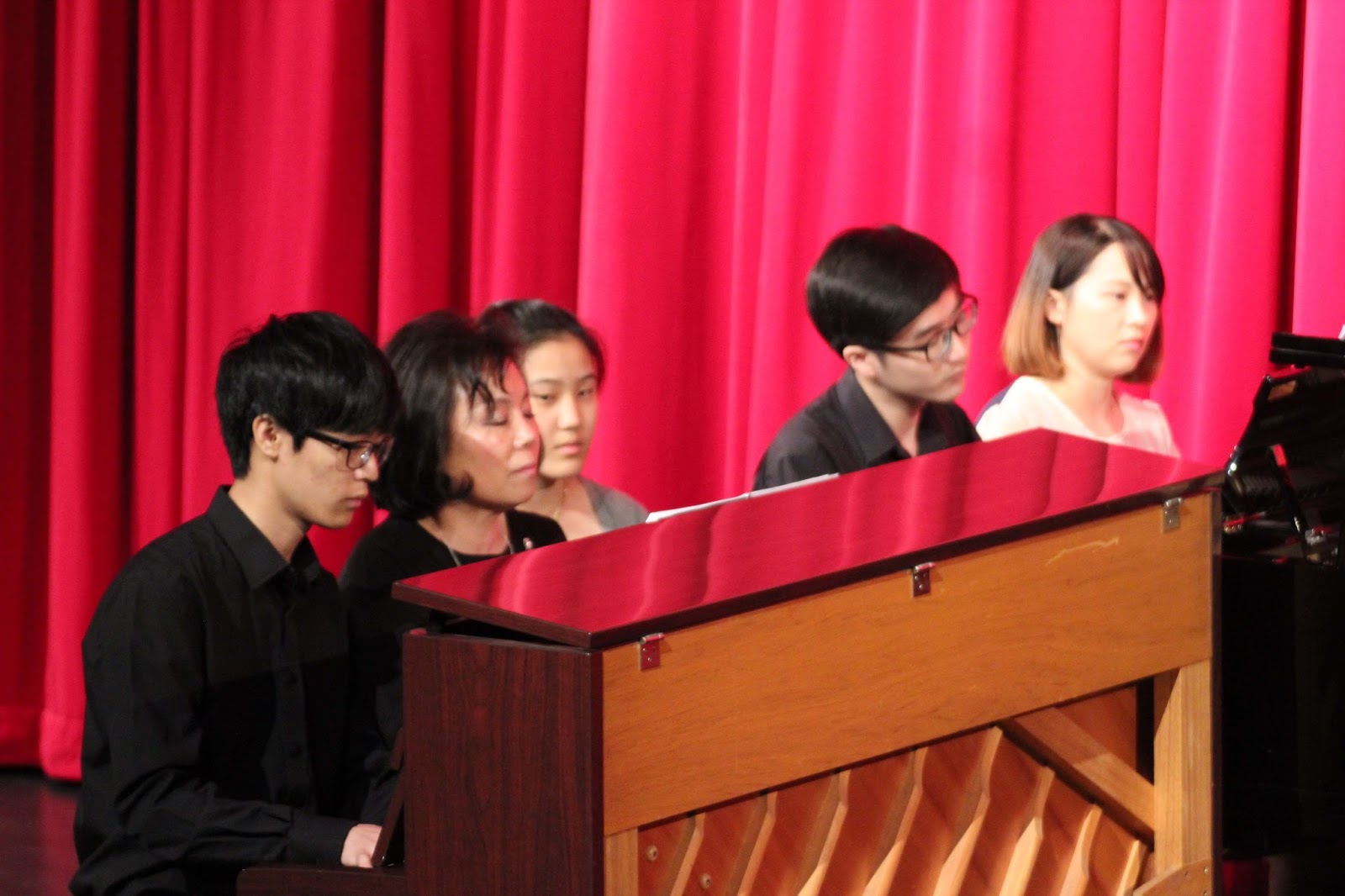
Piano Concert 2015


Leo Shin as the Host.


Rosa Shin & Chris Ryu playing Spring Song, composed by Felix Mendelssohn and arranged by Francis Shaw.


Naa-Eun & Bomi Kim playing Sonata in D major for Two Pianos K. 448 1st Movement, Allegro con Spirito, by Wolfgang Amadeus Mozart.


Andy & David Wang playing Golliwog's Cake-Walk from Children's Corner, by Claude Debussey.


Naa-Eun Kim & Winnie Zhang playing Eighteenth Variation for Two Pianos, from Rhapsody on a Theme of Paganini, by Sergei Rachmaninov. 


Rahil & Savesh John playing Lieberfreud, by Fritz Kreisler.


Rosa & Leo Shin and Joo-Eun Kim playing Concerto for Two Cellos in G minor, RV. 531 3rd Movement, Allegro, by Antonio Vivaldi.


Ahimsha & Abinaya Saravanapavan playing Witches' Flight, by H. M. Russell.


Dahvin Kim & Esther Oh playing Suite No. 1 for Two Pianos Op. 15 1st movement, Romance, by Anton Arensky. 


He-Min Lee & Miles Boermans playing Suite No. 1 for Two Pianos Op. 15 2nd movement, Waltz, by Arensky. 


He-Min Lee & Dahvin Kim playing Sonata in G major K. 357 lst movement, Allegro, by Mozart.


Rosa Shin, Jae Ho Lee, Irene Yang & Choong Won Park playing Fantasy on Themes from Bizet's Carmen, composed by Georges Bizet and arranged by Mack Wilberg.

Also, see Piano Concert 2014.