Monday, 28 June 2021

IFF Film Review: "I Am Love" ("Io sono l'amore") (2009).


From the director of Melissa P. and Call Me by Your Name comes I Am Love. This Italian romantic drama film directed by Luca Guadagnino and written by Guadagnino, Barbara Alberti, Ivan Cotroneo and Walter Fasano. At a dinner -- during which her husband, Tancredi, learns that he and his son Edoardo Recchi Jr. are about to assume control of the Edoardo Recchi Sr.'s lucrative business -- Emma meets a chef named Antonio. Antonio and Emma soon find themselves in bed together. With the family already divided over the elder Recchi's unusual plans, Emma's affair is the wild card that might divide the family for good.

By June 2008, Tilda Swinton, Edoardo Gabbriellini, Alba Rohrwacher, Pippo Delbono, Diane Fleri, Waris Ahluwalia, Marisa Berenson and Gabriele Ferzetti were cast in an Italian romantic drama with Guadagnino as director. Swinton and Guadagnino developed the film and tried to get it made for eleven years. At the same time, principal photography commenced and wrapped in August. Filming took place in Milan, Lombardia, Italy and throughout Liguria, Italy, as well as London, England. Swinton learned both Italian and Russian for the part, neither of which she spoke before filming. Gabbriellini said that when he was preparing for the role of Antonio, Guadagnino told him to watch Clint Eastwood in The Bridges of Madison County (1995) and also Ninetto Davoli in the films of Pier Paolo Pasolini to get an idea of how he wanted him to play the part. The first cut of the film was approximately two hundred and ten minutes long and the film's score comprises several works by Pulitzer Prize winning composer John Adams.

The film stars Swinton, Gabbriellini, Rohrwacher, Delbono, Fleri, Ahluwalia, Berenson and Ferzetti. The actors are superbly convincing. Swintont's performance is magnificent - this is the sort of performance that stretches across a lifetime. Swinton's performance is subtle but thorough, her body language conveys so many feelings... her stare is the reflection of the love he desires. 

The film frames the honesty of human feelings with a lucidity that transcends any sexual sphere. It is a good film. A modern-day Visconti, Guadagnino grants us entry into a world not only of wealth but of culture, which can be just as liberating. The director's use of location is almost too good to be true, and will likely make you want to book at trip to Italy immediately. This film is a beautifully shot lavish love letter to Italy, but even more, the slow unfolding of a love affair that meant something to two people who never thought it would blossom. This gently provocative new film is an insightful portrait of not just the awkward ungainliness of first love, but the intensely defining nature of how its effects define identities and trajectories. A masterpiece; a wise, wonderful, and perfectly crafted romance that lingers and enchants, standing tall as one of the finest cinematic achievements in recent memory. Guadagnino's film is sumptuous, sultry, and sincere. It's soaked with sensuality but defined by restrained tension and yearning expectation.

Simon says I Am Love (Io sono l'amore) receives:


Also, see my IFF review for Two Women (La ciociara).

Sunday, 27 June 2021

Film Review: "In the Heights" (2021).


"Turn Up the Volume on Your Dreams" with In the Heights. This musical drama film directed by Jon M. Chu, adapted by Quiara Alegría Hudes and based on the stage musical of the same name by Hudes and Lin-Manuel Miranda. The scent of a cafecito caliente hangs in the air just outside of the 181st Street subway stop, where a kaleidoscope of dreams rallies this vibrant and tight-knit community. At the intersection of it all is a likable, magnetic bodega owner who saves every penny from his daily grind as he hopes, imagines, and sings about a better life.

In early November 2008, Universal Pictures announced a cinematic adaptation of Hudes and Miranda's 2005 musical with Kenny Ortega hired to direct, a budget of $37 million and a 2011 release date. However, in March 2011, the project was cancelled due to the fact Universal was looking for a "bankable Latino star" instead of unknown actors. In January 2012, Miranda stated that the film adaptation was back under discussion. In May 2016, it was announced that Miranda would co-produce the film with Harvey Weinstein and backing from The Weinstein Company. In early June 2016, Chu was hired to direct. In the aftermath of numerous sexual misconduct allegations made against Weinstein, his producer credit on the film was removed, with the rights to the film eventually auctioned off to Warner Bros. for $50 million. Warner Bros. was one of several studios wanting to produce the film—due to the success of Hamilton; to persuade Miranda and Chu, they built a backlot bodega with piragua carts and set up performances of songs from the show. By early June 2019, Anthony Ramos, Melissa Barrera, Leslie Grace, Corey Hawkins, Olga Merediz, Jimmy Smits, Gregory Diaz IV, Daphne Rubin-Vega, Stephanie Beatriz, Dascha Polanco and Miranda were cast. At the same time, principal photography commenced and took place throughout New York City, New York, including Washington Heights. Christopher Scott served as choreographer. The vocal performances in the film are a mix of the actors singing live on-set, pre-recorded audio, and re-recorded in the studio during post-production. The production team's choice to use one or the others depended on the environment of the scene and tone of the song. The film was previously scheduled for a June 26, 2020 release date , but it was delayed to June 18, 2021, due to the COVID-19 pandemic, before being moved up to June 11, and finally to June 10.

The film stars Ramos, Barrera, Grace, Hawkins, Merediz, Smits, Diaz IV, Rubin-Vega, Beatriz, Polanco and Miranda. The cast astonishes with, not only their amazing musical numbers, but also with their dramatic moments.

The music is exhilarating, but the lyrics are a big surprise. The sense, as well as the sound of the sung dialogue, has been purposely suited to each character. In the end, Miranda's impassioned narrative of one community's story becomes the collective narrative of a nation, a nation built by immigrants who occasionally need to be reminded where they came from.

Simon says In the Heights receives:


Also, see my review for Crazy Rich Asians.

Saturday, 26 June 2021

IFF Film Review: "Two Women" ("La ciociara") (1960).


"Suddenly... Love Becomes Lust... Innocence becomes shame... As two women are trapped by violent passion and unforgettable terror!" This is Two Women (La ciociara). This Italian war drama film directed by Vittorio De Sica, adapted by De Sica and Cesare Zavattini, and based on the novel of the same name by Alberto Moravia. During World War II, Italian widow Cesira must leave Rome with her devout daughter when the city comes under attack by Allied forces. The pair flee to a small village, where they meet -- and both fall for -- the charming Michele. But the war uproots the life of mother and daughter once again when soldiers attack the duo and subject them to sexual assault. Their bond is strained as they struggle to overcome the tragedy that changes them both forever.

Producer Carlo Ponti bought the film rights to Moravia's 1957 semi-autobiographical novel of the same name, along with Marcello Girosi, for a reported US$100,000. The film had Sophia Loren and Anna Magnani attached to star, George Cukor was hired to directed and was going to be financed by Paramount. Cukor was going to direct as part of a two-picture deal with Ponti, the other one being Heller in Pink Tights (1960). The film was going to be shot as part of a six-picture deal between Ponti and Paramount. However, Cukor and Paramount dropped out. De Sica was then hired to direct. Magnani was originally cast as the mother and Lorean as the daughter, but was ultimately replaced by Loren due to illness and not want to play the role. It was Magnani herself who suggested Loren for the role, suggesting to director De Sica that if Loren (who was twenty-five years old at the time) would not mind playing a mother with an adolescent daughter, then the role should go to her. However, De Sica says it was his decision for Loren to play Magnani's role and cast a younger performer as the daughter. Ponti raised money from France and Italy. French investment was conditional upon a French star being used, which lead to the casting of Jean-Paul Belmondo, who had leapt to international fame in Breathless (1960). Belmondo's voice was dubbed into Italian. Principal photography took place in Fondi, Formia, Latina, Rome, Saracinesco, Sermoneta and Vallecorsa, Lazio, Italy

The film stars Loren, Jean-Paul Belmondo, Eleonora Brown, Raf Vallone, Andrea Checchi and Pupella Maggio. With this film, I believe this is where the world saw beyond Loren's beauty to her extraordinary talents. Loren shines in nearly every frame with her interpretation of Rosetta, a fierce and brave woman in the midst of war. 

The story of the film is simple but the film isn't simple at all. I love that at its heart it is a film about the journey and struggle of a woman and her relationship with her daughter. If there ever was a picture whose impact left one realizing that women who are tortured are the same in any country - this is the film.

Simon says Two Women (La ciociara) receives:


Friday, 25 June 2021

IFF Film Review: "Marriage Italian Style" ("Matrimonio all'italiana") (1964).


"You have never seen it before! A New torrent of emotions! A New Triumph of Film-Making from EMbassy Pictures who brought you "Divorce Italian Style" and "Yesterday, Today and Tomorrow" now brings you..." Marriage Italian Style (Matrimonio all'italiana). This Italian film directed by Vittorio De Sica, adapted by Leonardo Benvenuti, Renato Castellani, Piero De Bernardi and Tonino Guerra, and based on the play Filumena Marturano by Eduardo De Filippo. When handsome, successful Domenico first meets the sexy young waif Filomena in Naples during World War II, he is instantly smitten. Flash forward to the postwar years, and the two meet again, sparking a passionate affair that spans two decades. But when Filomena -- who has now become Domenico's kept woman and has secretly borne his children -- learns that her lover is planning to wed another, she stops at nothing to hook him into marrying her instead.

Written in 1946 by De Filippo, an Italian playwright, actor and poet, and was initially written as a tribute to his sister Titina De Filippo, a famous Neapolitan theatrical actress, who took the title role in the first production in Naples. The first night of the new play, proved a disappointment however, and received lukewarm notices from the Neapolitan theatre-going public. Titina decided to address this by following her own instincts and performing as she felt the role required. She was proved right. The play achieved great success. Thanks to an arrangement made by Carlo Trabucco, the editor of the daily Italian Christian Democrat newspaper Il Popolo, an audience was arranged for the cast to meet Pope Pius XII in a private audience in the Vatican. At the audience, the pope unexpectedly asked to hear one of the monologues, and Titina recited for him the prayer of Filumena to the Madonna of the Roses. In 1977, an English language version of the pay by Keith Waterhouse and Willis Hall played at the Lyric Theatre in London directed by Franco Zeffirelli and starring Colin Blakely and Joan Plowright. This won The London Theatres Comedy of the year award in 1978. The production was taken to New York City where it opened in 1980 at the St. James Theatre on Broadway where it ran for thirty-two performances. Before the New York transfer, it had a run in Baltimore where it was directed by Laurence Olivier (husband of Plowright). The play was performed at the Piccadilly Theatre, London, opening in 1998 and running until 1999. It was directed by Peter Hall with Judi Dench in the title role and Michael Pennington played Domenico. The play is also the basis for the 1950 Spanish language Argentine musical film Filomena Marturano, multiple Italian adaptations under its original title.

The film stars Sophia Loren and Marcello Mastroianni. Loren created an altogether different yet iconic interpretation of the ex-prostitute character. Mastroianni perfectly embodied the arrogant but charming wealthy aristocrat. The chemistry between the two actors was dynamite in every sense.

Not at the same level as Bicycle Thieves or Two Women, but it's another masterpiece all the same, bringing a much-needed humor, warmth, and sexuality to the director's work.

Simon says Marriage Italian Style (Matrimonio all'italiana) receives:


Also, see my IFF review for The Leopard (Il Gattopardo).

Thursday, 24 June 2021

IFF Film Review: "The Leopard" ("Il Gattopardo") (1963).


"Luchino Visconti's Enduring Romantic Adventure" This is The Leopard (Il Gattopardo). This Italian epic historical drama film directed by Luchino Visconti, adapted by Visconti, Enrico Medioli, Massimo Franciosa, Suso Cecchi d'Amico, Pasquale Festa Campanile and René Barjavel, and based on the 1958 novel of the same name by Giuseppe Tomasi di Lampedusa. As Garibaldi's troops begin the unification of Italy in the 1860s, an aristocratic Sicilian family grudgingly adapts to the sweeping social changes undermining their way of life. Proud but pragmatic Prince Don Fabrizio Salina allows his war hero nephew, Tancredi, to marry Angelica, the beautiful daughter of gauche, bourgeois Don Calogero, in order to maintain the family's accustomed level of comfort and political clout.

In August 1960, Italian studio Titanus Film announced a cinematic adaptation of Tomasi di Lampedusa's 1958 bestselling novel of the same name to be filmed in Sicily the following summer with a budget of $2 million. The film would be an Italian-American co-production, shot in various languages, with a combination of Italian and American stars. Several treatments were reportedly done before Visconti became involved. In July 1961, MGM announced they had signed a co-production deal with Titanus to make the movie. Warren Beatty was in discussions with Visconti to play the nephew, while Visconti approached Laurence Olivier and Spencer Tracy to play the lead. Visconti was told by producers that they needed to cast a star in order to ensure that they'd earn enough money to justify the big budget. The producers recommended that the star should be either Gregory Peck, Anthony Quinn, Spencer Tracy or Burt Lancaster. In November, Lancaster agreed to play the lead with filming to start in April. The producers chose Lancaster without consulting Visconti, which insulted Visconti and disappointed as felt he was not right for the part. This caused tension between the two during the first few weeks of filming. Visconti's harsh treatment toward Lancaster eventually led to the actor publicly confronting him on the set. Visconti was so impressed with the passion and sincerity that Lancaster displayed during his tirade that the two developed a close and amicable relationship for the rest of the filming process. Principal photography took place in Palermo, Sicily and Rome, Lazio, Italy. All the scenes with Lancaster would be shot in English, and dubbed into Italian for the Italian version; other scenes would be filmed in Italian then dubbed into English for the English version. Lancaster was dubbed by Corrado Gaipa, and his French co-star Alain Delon was dubbed by Carlo Sabatini. In April 1962, 20th Century Fox announced it had bought the distribution rights to the film.

The film stars Burt Lancaster, Alain Delon, Claudia Cardinale and Terence Hill. The film is another of Visconti's elegantly composed portraits of the follies of the aristocracy, thanks to the superb performances given by the cast of international talents.

The film is the culmination of Visconti's work, the perfect collision of style, themes and look, and perhaps his greatest film. However long it may be, it can only strengthen Visconti's position as one of the major directors of the contemporary cinema.

Simon says The Leopard (Il Gattopardo) receives:


Sunday, 20 June 2021

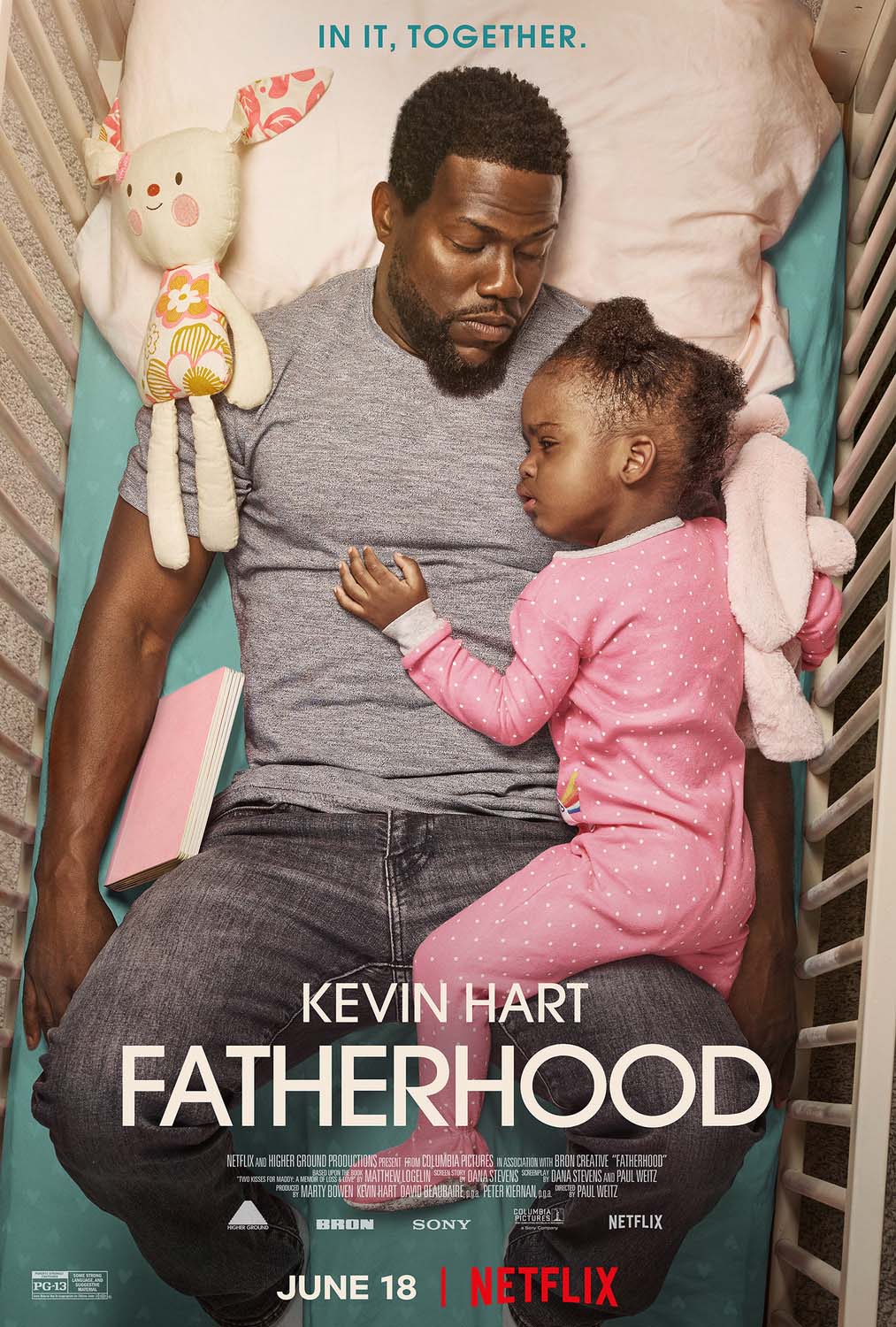
Film Review: "Fatherhood" (2021).


"In It, Together." This is Fatherhood. This comedy-drama film directed by Paul Weitz, adapted by Weitz and Dana Stevens, and based on the 2011 memoir Two Kisses for Maddy: A Memoir of Loss and Love by Matthew Logelin. A widowed new dad copes with doubts, fears, heartache and dirty diapers as he sets out to raise his daughter on his own. Inspired by a true story.

In May 2015, it was announced that Channing Tatum would star in and produce a cinematic adaptation of Logelin's memoir, with TriStar Pictures distributing. In January 2019, it was reported Kevin Hart would headline the film, replacing Tatum, with Paul Weitz directing from a screenplay he wrote alongside Dana Stevens. Principal photography took place in Montréal, Québec, Canada and Boston, Massachusetts, USA. There film was initially scheduled for an April 3, 2020 release date, but in early January 2020, it was delayed to January 8, 2021. Later that year, it was pushed back a week to January 15, 2021. In late March, it was brought forward to October 23, 2020 due to the COVID-19 pandemic. In late April 24, it was delayed to April 2, 2021, and on in late November, it was delayed again to April 16, 2021. It was then announced that Netflix had acquired the worldwide distribution rights to the film from Sony Pictures Releasing, and set it for a June 18, 2021 release date.

The film stars Hart, Alfre Woodard, Lil Rel Howery, DeWanda Wise, Anthony Carrigan, Paul Reiser, Frankie Faison and Melody Hurd. Even people who don't usually like Hart will be charmed by him in this poignant comedy. Hart, seeming to get better the further he's allowed to extend his range, delivers a terrific central performance, as acerbic but more complex than his usual silly schtick. No movie has ever made better use of Hart's acting capabilities and dramatic potential than this dramatic adaptation of Logelin's best-selling memoir. Hart is best when he sticks with roles that let him be a lovable cad - exactly the sort of character offered to him in this film. Both Hart and Hurd carry the movie because they are believable as father and daughter -- loving and flawed, assured yet uncertain, and ready to tackle anything that life throws at them. Thanks to the cast, the characters are people we care about and relate to; the fact that they speak with flair and wit makes them funnier, but no less human. The movie is a gem.

This is a film that plumbs the depths of single parenthood and ultimately family, doesn't pull any punches, and approaches all of these themes from a personal angle that makes them accessible. It's a complex emotional soup, taken from a 2011 memoir by Logelin, and one that demands much from all involved. Despite all this, Weitz and his camera are infatuated with Hart, who is performing more than he is acting in a film that only he and the director don't understand is more suited to the latter.

Simon says Fatherhood receives:


Also, see my review for Bel Canto.

Film Review: "F9: The Fast Saga" (2021).


"Not All Blood Is Family" in F9: The Fast Saga. This action film directed by Justin Lin, written by Daniel Casey and based on the Characters by Gary Scott Thompson. It is the sequel to The Fate of the Furious (2017), as well as being the ninth main installment, and the tenth full-length film released overall in the Fast & Furious franchise. Dom Toretto is leading a quiet life off the grid with Letty and his son, little Brian, but they know that danger always lurks just over their peaceful horizon. This time, that threat will force Dom to confront the sins of his past if he’s going to save those he loved most. His crew joins together to stop a world-shattering plot led by the most skilled assassin and high-performance driver they’ve ever encountered: a man who also happens to be Dom’s forsaken brother, Jakob.

In November 2014, Universal Pictures chairwoman Donna Langley told The Hollywood Reporter that there would be at least three more films in the franchise after Furious 7 (2015). In October 2017, Vin Diesel revealed in a Facebook live video that Lin, director of Fast & Furious 6 (2013), would be returning for the ninth and tenth films. In May 2018, Casey was hired to pen the script after Morgan left due to his work on Fast & Furious Presents: Hobbs & Shaw (2019). By June 2019, Diesel, Michelle Rodriguez, Tyrese Gibson, Chris "Ludacris" Bridges, Jordana Brewster, Nathalie Emmanuel, Sung Kang, Helen Mirren, Kurt Russell and Charlize Theron reprise their roles, whilst new comers John Cena and Michael Rooker round out the film's cast. At the same time, principal photography commenced and wrapped in early November. Filming took place in Rustavi and Tbilisi, Georgia, as well as Edinburgh, Scotland and Greenham Common, England, UK. The film was originally set for a May 22nd, 2020 release date , but in mid March 2020 it got pushed back a year due to the COVID-19 pandemic. The film was then pushed to April 2nd, 2021, taking over Fast & Furious 10. In early October 2020 it was pushed back yet again to May 28th, 2021, in order to avoid competition with No Time to Die (2021).

The film stars Diesel, Rodriguez, Gibson, Ludacris, Brewster, Emmanuel, Kang, Mirren, Russell and Theron reprise their roles, whilst new comers Cena and Rooker. Despite how over-the-top all the action scenes are, the cast earned nothing but eye-rolls from me, and while we can argue that each character deserves their moment to shine, I am of a mind that these characters are expendable. Moments that should've been emotional, are quickly forgotten thanks to the cast's robotic and cartoonish acting.

Who would have thought that a street racing movie from 2001 starring Vin Diesel and Paul Walker would still be going... But there's no setup, no details, and no plan - just the getaway, where things explode and collide with one another like objects in a cartoon.

Simon says F9: The Fast Saga receives:


Also, see my reviews for Star Trek Beyond and The Fate of the Furious.