Saturday, 23 July 2016

NZIFF Film Review: "Bleak Street" ("La calle de la amargura") (2015).


From the director of Seduction and Deep Crimson comes Bleak Street (La calle de la amargura). This Mexican crime film directed by Arturo Ripstein, and written by Paz Alicia Garciadiego. In the early morning hours, two elderly whores go back to their hovels. They are not tired from working. They are tired of not doing do. One has problems at home with her teenage daughter and her cross dressing husband. The other, with her loneliness. But that night, they have a date to celebrate the victory in the ring of two wrestlers, twin midgets wearing masks. At the hourly hotel, in order to rob the tiny men of their earnings, they drug them with eye drops. But the dose proves fatal. They murder them unintentionally. Scared and confused, they decide to hide from the police and run away together to live, as they always have, on Bleak Street.

The film stars Alberto Estrella, Silvia Pasquel, Arcelia Ramirez, and Patricia Reyes Spíndola. Pasquel and Ramirez treat the heroines' atonements and friendships with great feeling, but there's a dark side to the film's poignancy, because the Woman's every encounter may be her last.

Bleak Street doesn't cover any new terrain for Ripstein - which some may complain about - but its terrain that he knows well. Ripstein applies his usual degree of cinematic imagination to the sordid tale. This monstrous love story serves up film noir at its most darkly authentic: it plays for keeps. This is a chilling tale by one of Mexico's most respected directors. The overriding fault for this art-house film was that it is not poetic. There are more virtues than debits to Bleak Street, and Crime fans should be relatively satisfied. The film turns the showdown narrative of so many oaters into an actively intelligent, darkly funny and no less suspenseful rumination on the pull of the horizon versus the ill wind at the back. On the whole, sharp dramatization and direct performances suffice to put the story's themes across more urgently than expected. It's a swift slow burn of a film, the story of a man who once got pushed too far with terrible results now getting pushed too far again, with results that are, as the title suggests, sure to be worse. At once repellant and enthralling, exotic and familiar, but never anything short of fascinating. Ripstein is more interested in the women's relationships with the people outside of work than with their clients, though we do get to see them living out some of their patrons' kinky desires. It's about forcing us to think about people we never would otherwise and seeing their struggles and humanity. What gives the film its haunting pull, as well as its feminist undercurrent, is the filmmaker's palpable compassion for these women. There's plenty of flesh on display but the stories are far from erotic. It emphasizes setting over character and plot; and it casts a mood that's both eerie and entrancing. Overall, the film is worthwhile, but more interesting than good.

Simon says Bleak Street (La calle de la amargura) receives:


Also, see my review for Happy Hour (ハッピーアワー).

NZIFF Film Review: "Happy Hour" ("ハッピーアワー") (2015).


"A unique experience." This is Happy Hour (ハッピーアワー). This Japanese drama film directed by Ryūsuke Hamaguchi and written by Hamaguchi, Tadashi Nohara and Tomoyuki Takahashi. The film is a slow-burning epic chronicling the emotional journey of four women in the misty seaside city of Kobe. All in their thirties. Three married and one divorcee. They are able to tell each other anything. Or at least they thought. One day, after losing in divorce court, one of them gives up on a future with their partner and disappears. The three remaining women take a second look at their lives. The long night is full of questions. 'Are you really the you you wanted to be?' As they navigate the unsteady currents of their work, domestic, and romantic lives a sudden, unexpected rift opens between that propels each to a new, richer understanding of life and love. 

The film was first developed while Hamaguchi was an artist in residence at KIITO Design and Creative Center Kobe in 2013. It came out of an improvisational acting workshop he held for non-professionals, with many of the film's performers having participated in the workshop.

The film stars Sachie Tanaka, Hazuki Kikuchi, Maiko Mihara, and Rira Kawamura. Thanks to the strong performances given by Tanaka, Kikuchi, Mihara, and Kawamura, we see them fully in all their thorny complications as we spend so much time with these ordinary women.

With great warmth and poignancy, Hamaguchi's Happy Hour is perhaps one of the most satisfyingly nuanced portraits of the profundity lurking beneath the day-to-day grind. Running nearly five and a half hours, Hamaguchi's movie foregrounds the quotidian, revealing the latent drama in the most seemingly mundane moments. However, Hagamuchi does not waste the five plus hour film time and allows us to get to know, intimately, each of the ladies, their lives, hopes and fears Hamaguchi offers great perspectives into the dynamics of friendship, marriage and the unknowability of others, shedding surprising light on the men in these women's lives in his final acts. Hamaguchi proposes a life-world in which the experiences that are really supposed to rearrange our daily identities actually do. It's worth putting aside the time to see how the film excels in every way a narrative film can. Through small glances and brief, cautious words, Hamaguchi conveys volumes. Buoyed by four captivating performances from its unheralded actresses, Happy Hour is a fascinating, towering confection of contradictions. In the film, and particularly in that beautiful scene on the ferry, the world is not just gliding by-it is being slid into place before our eyes, as if for the first time. The film commands respect through the audacity of its conception and scale, and it earns affection through its humane attentiveness. Hamaguchi is a genius of scene construction, turning the fierce poetry of painfully revealing and pugnaciously wounding dialogue into powerful drama that's sustained by a seemingly spontaneous yet analytically precise visual architecture. If the film doesn't quite deliver all it promises, that may only be because it promises quite a lot.

Simon says Happy Hour (ハッピーアワー) receives:


Also, see my NZIFF review for One-Eyed Jacks.

Friday, 22 July 2016

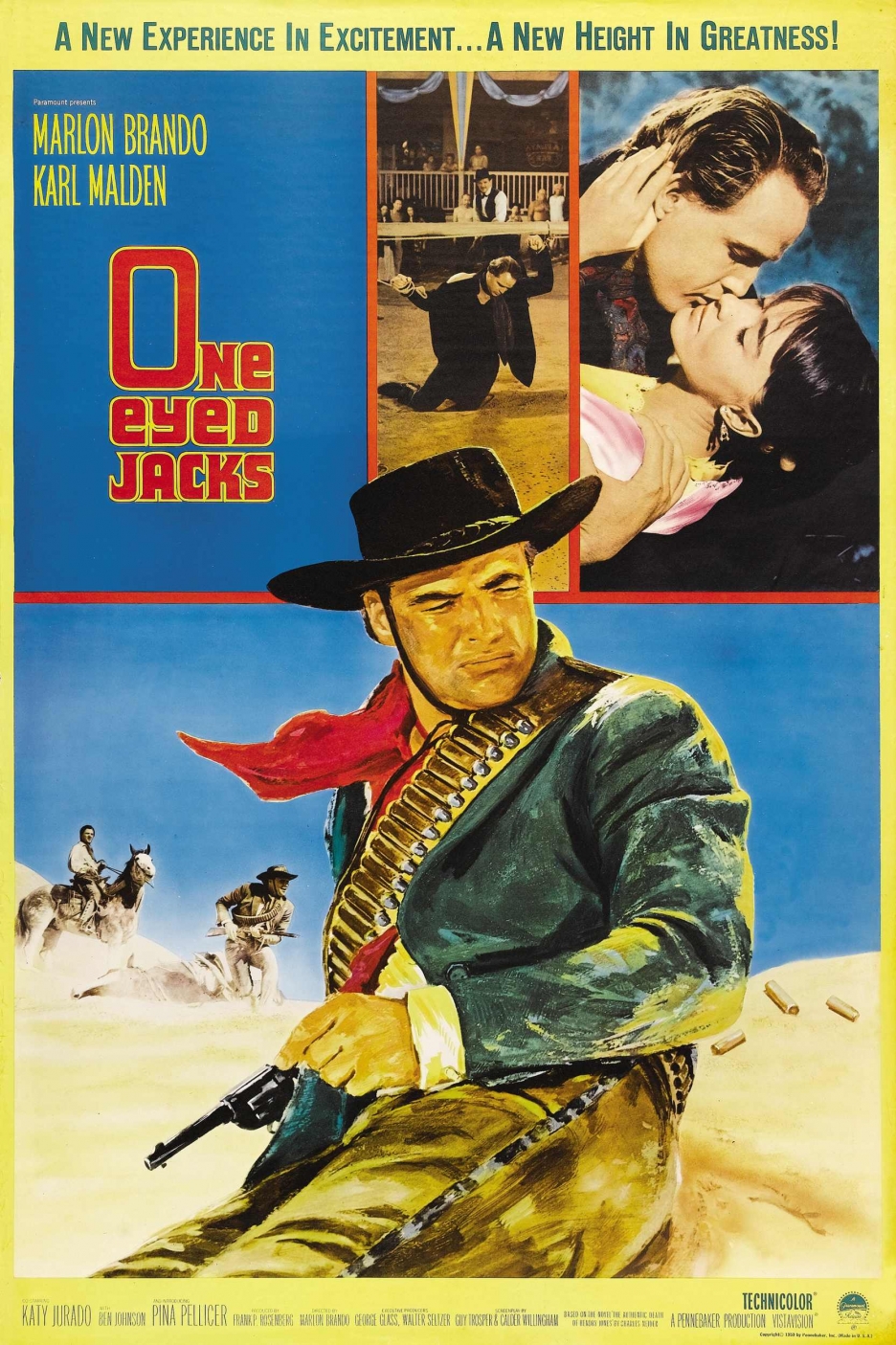
NZIFF Classic Film Review: "One-Eyed Jacks" (1961).


From the original marketing campaign, One-Eyed Jacks was sold as "the motion picture that starts its own tradition of greatness". This Western film directed by Marlon Brando (his only directorial effort); written by Guy Trosper and Calder Willingham; based on the novel The Authentic Death of Hendry Jones by Charles Neider. After a Mexican bank robbery gone wrong and being abandoned by his partner Dad Longworth, Rio was captured. Five years later, Rio escapes from the prison where he has been since and starts to hunt down Dad for revenge. However what it is not known to Rio is that Dad is now a respectable sheriff in California.

The novel was a fictional treatment of the familiar Billy the Kid story, relocated from New Mexico to the Monterey Peninsula in California. After buying the rights to the novel, producer Frank P. Rosenberg contacted writer Rod Serling to write a draft. Serling's draft was ultimately rejected. Rosenberg next hired Sam Peckinpah to rewrite it. Peckinpah finished his draft in November 1957. Brando's Pennebaker Productions signed a contract with legendary filmmaker Stanley Kubrick to direct. Peckinpah handed in a revised draft in May 1959. Kubrick, Brando and Rosenberg then fired Peckinpah and brought in Calder Willingham for further rewrites. But due to creative differences, Brando and Rosenberg fired Kubrick and Willingham, and brought on Guy Trosper for rewrites. Ultimately, Brando took over as director. The production ultimately suffered from being extremely over schedule and extremely over budget. Filming began in late 1958, and did not wrap until late 1960. Brando's inexperience behind the camera was obvious on set. He shot six times the amount of footage normally used for a film at the time. He was indecisive and ran extremely overlong in getting the film finished. Brando's first cut of the film was allegedly five hours long. Paramount eventually took the film away from him and recut it. On a budget of $6 million, the film was a commercial flop at the box office. To help offset the costs, Brando persuaded Universal to pick up the tab. In return, he agreed to make five films for the studio: The Ugly American (1963), Bedtime Story (1964), The Appaloosa (1966), A Countess from Hong Kong (1967) and The Night of the Following Day (1968), all of which were also commercial flops.

The film stars Brando, Karl Malden, Katy Jurado, Ben Johnson, Slim Pickens and Pina Pellicer. The cast gave superb performances thanks in large part to Brando, who is undeniably one of the greatest actors who ever lived. He knew how to guide them.

Brando obviously didn't know how to direct or edit, but he respected the material and his fellow performers enough- and that's good enough with me. Yes, it's stale at times, but One-Eyed Jacks exudes confidence in its dullness. And it never actually treated the subject as light or inconsequential. Don't get too hopeful for the "greatness" it was trying to sell. Ultimately, it is an ambitious but generic western movie.

Simon says One-Eyed Jacks (1961) receives:


Also, see my NZIFF review for Land of Mine (Under dem Sand).

Thursday, 21 July 2016

NZIFF Film Review: "Land of Mine" ("Unter dem Sand") (2015).


"They survived World War II. Now they have to survive the clearing." This is Land of Mine (Unter dem Sand). This Danish-German historical drama war film written and directed by Martin Zandvliet. The film follows a group of German prisoners of war who are forced to dig up millions of Nazi land mines with their bare hands along the coast of the North Sea in Denmark.

It is believed that more than 2,000 German soldiers were forced to remove mines, and nearly half of them lost their lives or limbs. In July 2014, principal photography commenced, and wrapped in August. Filming took place at the historically authentic locations, including in Oksbøllejren and areas in Varde. The use of the historical beaches led to the discovery of a real mine during the production. Prior to filming, the actors were trained in mine clearance 'anno 1945' at the Military Training Compound 'Oksbøl'. During training they found a 'live' mine. It had been there for seventy-plus years - and was in fine working condition. The mine was removed and disarmed by the danish de-mining experts.

The film stars Roland Møller, Mikkel Boe Følsgaard, Laura Bro, Louis Hofmann, and Joel Basman. The cast here, especially the young ones, are superb at conveying the young, world-weary minds pummelled, or blown to pieces, by the horrors of seeing their fellow soldiers die by either war or land mines.

This striking, slow-building drama from Zandvliet uses graphic imagery in order to reflect the horrors of the soldiers against the land mines in an unfamiliar landscape. If everything the soldiers left to dig up the land mines have been taught this. A beautifully crafted film, it may be, but it is by no means a bourgeois film. It is a rebuke to expected notions of World War II, as well as a formidable work in its own right. Zandvliet's film proceeds like a long-ago pseudo dark-hued documentary drama grounded in real-life 20th-century horrors. The sins of the Fatherland sent German soldiers to dig up death in Zandvliet's vividly rendered and terrifying drama. With a soldier's perspective on war, the film deserves comparisons with Platoon (1986), and with young German soldiers as its protagonists, it stands virtually alone. The film is not a pretty story, but it is a good and sadly believable one. Zandvliet's tough, moving film is shot with great intimacy, driving home the idea that great horrors are ultimately a personal responsibility. Zandvliet has created a moving, intriguing and complex film, which provides one of the most intelligent and honest approaches to both Nazism and the aftermath of World War II seen on screen in recent years. A raw, urgent yet contemplative tone infuses every moment and, courtesy of cinematographer Camilla Hjelm Knudsen, Zandvliet uses the country's vast, devastated landscape to stunning effect. The film's textures and colours evoke equal parts wonder and horror. Remarkable, raw, and disorienting, it never bothers to tell you what it can instead show.

Simon says Land of Mine (Under dem Sand) receives:


Also, see my NZIFF review for Swiss Army Man.

NZIFF Film Review: "Swiss Army Man" (2016).


"We all need some body to lean on." This is Swiss Army Man. This absurdist black comedy film written and directed by the Daniels, in their respective feature directorial debuts. Hank is stranded on a deserted island, having given up all hope of ever making it home again. But one day everything changes when a corpse named Manny washes up on shore; the two become fast friends, and ultimately go on an epic adventure that will bring Hank back to the woman of his dreams.

By mid July 2015, Paul Dano, Daniel Radcliffe and Mary Elizabeth Winstead were cast in an absurdist black comedy film written and to be directed by Scheinert and Kwan, in their respective feature directorial debuts. At the same time, principal photography commenced and wrapped in early August. Filming took place in Los Angeles, San Pedro, Humboldt and Redwood City, California.

The film stars Dano, Radcliffe, and Winstead. Dano should earn himself a well-deserved best actor Oscar nomination, carrying much of the action without talking to anyone but himself for a dead body he finds on an island. Radcliffe made more faces and dragged around with his mouth open more than I might have liked, but he has a way of revealing his thoughts without words that kept me intrigued. The challenge to the character is matched by the challenge to the actor; for most of the movie Dano is the only human being we see or hear. He tackles the job with stunning confidence in a performance stripped of gimmicks and driven by need. Dano's Everyman quality has never been more aptly utilized: He's the perfect stand-in for all of us who never made it to Eagle Scout. In addition to Dano's superb acting, Radcliffe's amazing performance helps lift this movie above the ordinary.

The film is an exceptionally well-crafted exploration of the survival of the human spirit. It's a film unafraid to consider the full complexity of life. As melancholy as it is affirming, the film tells a darkly comic, occasionally punishing parable about what happens when humans lose sight of humility in life's grand scheme. Remains one of the more vividly transporting films I've come into contact with. It's heartbreaking, darkly comedic, bravely observational, and ultimately, pure emotional poetry. Though Dano comes across as blandly as ever, at least his solid performance shows he's up to carrying half a movie on his own, and the Daniels' direction is at first as busily efficient as the protagonist. This isn't a first time a long-awaited movie has turned out to be a crushing disappointment and it won't be the last, but the loss is made even more wrenching when one considers how little it would have taken to make the film a great one. If all of the film were as gripping as its long midsection, it would be overwhelming; still, even with its flaws, it marks another milestone performances for Dano and Radcliffe as well as for the Daniels.

Simon says Swiss Army Man receives:


Also, see my NZIFF review for The Red Turtle.

Wednesday, 20 July 2016

NZIFF Film Review: "The Red Turtle" (2016).


"Presented by Studio Ghibli, the people who brought you Spirited Away, Ponyo, and The Wind Rises" comes The Red Turtle. This animated fantasy drama film directed by Dutch animator Michaël Dudok de Wit, written by Pascale Ferran, and produced by Wild Bunch and Studio Ghibli. Through the story of a man shipwrecked on a tropical island inhabited by turtles, crabs and birds, the film recounts the milestones in the life of a human being.

Hayao Miyazaki saw Dudok de Wit's short film Father and Daughter (2000) and wanted to make a feature film with him. In 2008, Vincent Maraval, head of Wild Bunch, visited Studio Ghibli and met with Miyazaki. Miyazaki showed him the short film and asked him to find Dudok de Wit, with the prospect of co-producing a feature film with Dudok de Wit as director. Maraval approached Dudok de Wit in London and convinced him to take on the project.

The film stars the voice talents of Emmanuel Garijo, Tom Hudson, Baptiste Goy, Barbara Beretta, Maud Brethenoux, Mickaël Dumoussaud, Elie Tertois, and Axel Devillers. While the characters feel very simplified at times, there are scenes that put great weight on performance and subtle expressions, in a way that's nearer to the classical American tradition than most Japanese animation.

Everything in it exudes a special magic that emanates in a slow and leisurely narrative rhythm, that transports us unfailingly to another time. The result is a pleasing, if bloated and simplistic, experience destined to be overpraised because of its lauded creative team. The material might be fantastical, yet due to the universal themes of womanhood and true happiness, the film's story is exceptionally grounded. A great, grounded realist with a firm eye but a light touch, Dudok de Wit's leisurely feature film directorial debut has a rare serenity and grace. In an era where anime films seem to blend into each other aesthetically, Dudok de Wit's impressions seems marvelously alive - its modesty in images makes them feel as if they're being created before our very eyes. There exists a compelling experiential satisfaction of the closure of a mythical character journey full of ebbs and flows, complexities and emotional introspection, all expressed fully in the compassionate drawings of Dudok de Wit. Flurries of expressiveness swirl into subtle shifts in style; it's these fiercely elemental illustrations of one girl's forbearance, defiance and longing which mark Dudok de Wit's film as one of Studio Ghibli's final masterpieces. A hauntingly mesmeric masterpiece that creeps beneath the skin and truly transports the viewer into an enchanting world of myth and magic. A poignant gem, very different in tone to the studio's most celebrated works, Grave of the Fireflies and Spirited Away, but no less worthy of praise and admiration. No one goes to Studio Ghibli for incident. This is a film-making model that favours contemplation over manufactured climaxes. The Red Turtle is one of the most beautifully animated films of this or any other year. A mezmerizing display of impressionist animation.

Simon says The Red Turtle receives:


Also, see my NZIFF review for A Touch of Zen (侠女).

Tuesday, 19 July 2016

NZIFF Film Review: "High-Rise" (2016).


"Welcome to the high life..." in High-Rise. This British dystopian horror film directed by Ben Wheatley, adapted by Amy Jump, and based on the 1975 novel of the same name by J. G. Ballard. Life for the residents of a tower block begins to run out of control. As the residents break into tribal factions, Laing finds himself in the middle of mounting violence.

As with Ballard's previous novels Crash (1973) and Concrete Island (1974), High-Rise inquires into the ways in which modern social and technological landscapes could alter the human psyche in provocative and hitherto unexplored ways. Since its publication in 1975, British producer Jeremy Thomas had wanted to make a film adaptation of Ballard's literary classic, with Nicolas Roeg as director and Paul Mayersberg to pen the adaptation. However, the project fell apart in the early stages and ultimately entered into development hell. In early 2009, Thomas began developing the project again with Vincenzo Natali as director and Richard Stanley to pen the new adaptation, with the film intended as a loose adaptation of the novel. Natali was very happy with Stanley's script. However, the project fell apart once again. In 2013, Wheatley started looking into who held the rights to the book, which led him to Thomas and was ultimately hired to direct, with Wheatley's wife, Jump, hired to pen the new adaptation. In February 2014, Tom Hiddleston was cast in the lead role. By July 2014, Jeremy Irons, Sienna Miller, Luke Evans, Elisabeth Moss, James Purefoy, and Stacy Martin rounded out the film's cast. At the same time, principal photography commenced, and took place in Belfast and Bangor, Northern Ireland.

The film stars Hiddleston, Irons, Miller, Evans, Moss, Purefoy, and Martin. The film is about characters who entranced by each other sexually. Wheatley has made a film that is pornographic in form, but not in result. High-Rise like a porno film made by a decadent pervert: It unapologetically monologues about class and sex, it discovers our twisted and minds towards class and sex, and it combines them in a mistaken speech. The result is challenging, courageous and original—a dissection of the philosophy of pornography. I admired it, although I cannot say I "liked" it.

Despite the surprisingly distant, clinical direction, High-Rise's explicit premise and sex is classic Ballard territory. It is necessarily disturbing and equally profound inquiry into class and human desire, however self-destructive. Unlike Crash (1996), it's the polar opposite logic of Darwin, where libertarians refused to leave their past behind as if it were dead. The film is a violently rare exception to the continually careful stride of film, and few films have been made with such a conviction to such inherently controversial material. With High-Rise, Wheatley pushes arthouse cinema off the balcony. The film is a mutant work of art - a bracing splash of champagne and cocaine with ice. It's a dark, disturbing, languorous movie, as ludicrous, hermetic and repetitive, perhaps, as Ballard's original, but admirably assured and true to itself. A stylish, intriguing and typically warped vision that hybridises the imaginations of Ballard and Wheatley.

Simon says High-Rise receives:


Also, see my reviews for Sightseers and The Eagle Huntress.